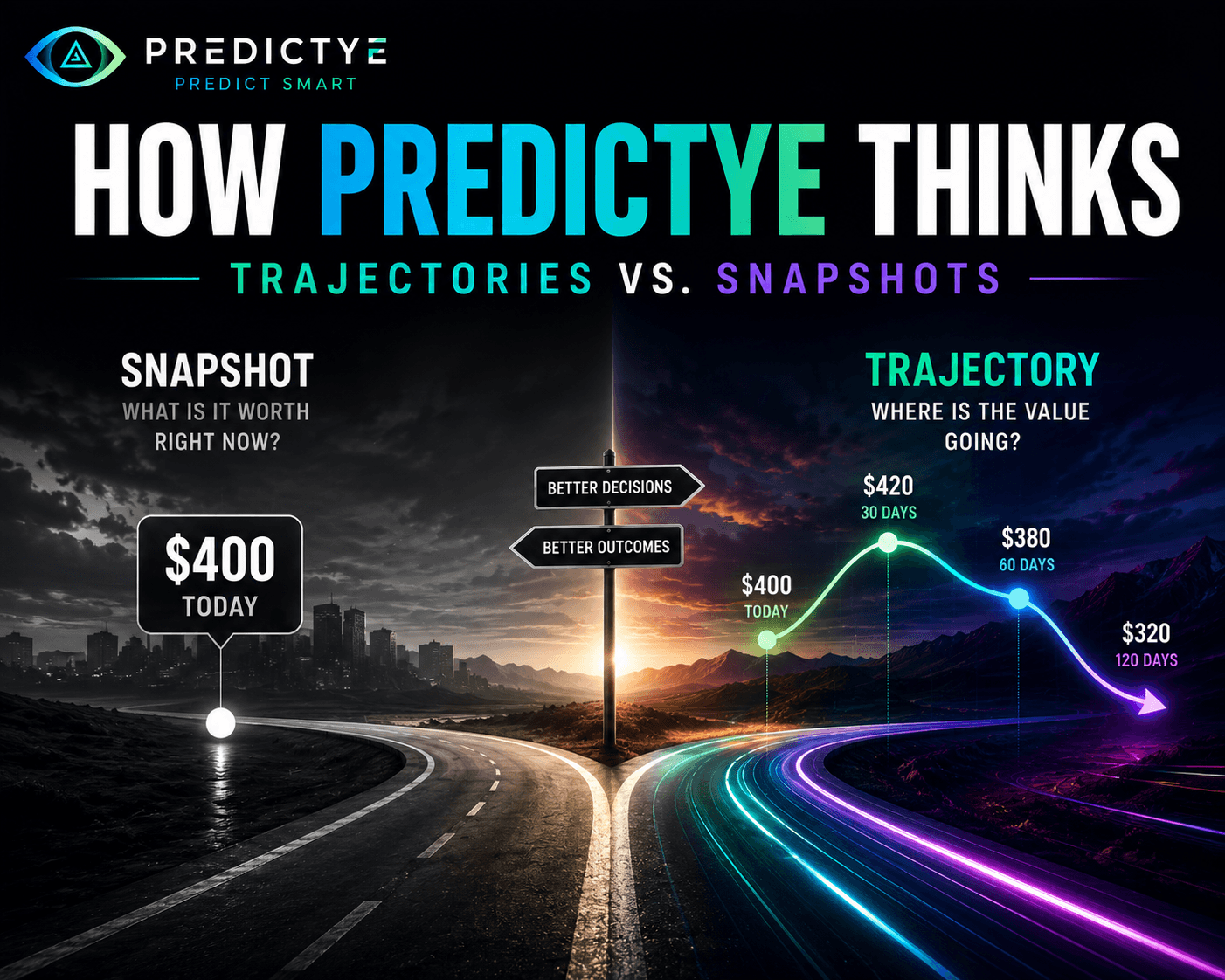
Most tools answer one question: what is it worth right now?
Predictye answers a different question: what will it be worth?
That difference is everything.
The Snapshot Problem
Every existing tool works the same way. Upload an item. Get a current price. That's it.
eBay shows listings. Depop shows recent sales. Zillow shows comps. Facebook Marketplace shows asking prices.
All snapshots. All current. None of them answer the actual question people ask when making a decision.
A phone is worth $400 today. But is it about to drop? Is it stabilizing? Is it moving up? Nobody knows. Because nobody is showing trajectory.
Consider what happens when you only see the snapshot. You list a phone for $400. You wait three weeks. Meanwhile, a new phone announcement drops the secondary market to $320. You end up selling for $340 after negotiation. You could have gotten $420 if you sold before the announcement.
That's not a transaction problem. That's a decision problem. You had a snapshot. You didn't have direction.
Why Snapshots Fail
The snapshot approach fails for a fundamental reason: prices move constantly.
A phone purchased for $1,200 is worth $400 a year later. But that's the destination. The path matters. Was it worth $800 at month 6? Was it $500 at month 9?
When should you sell? If prices are dropping but haven't bottomed, you might want to wait for stabilization. If prices are stable but about to spike seasonally, wait. If prices are declining and will continue declining, sell now. Each decision requires knowing the trajectory.
A Rolex sports model appreciates roughly 3% per year. A Seiko from the same era depreciates 5% per year. Same product category. Opposite trajectories. If you're buying, trajectory determines whether the purchase makes financial sense.
The Trajectory Solution
Predictye thinks about trajectories instead.
Not "what is it worth today" but "where is the value going? And when?"
A phone is worth $400 today. But the trajectory might look like this: $420 next month (holiday demand), $380 in 6 weeks (new model announcement), stabilize at $320 in 12 weeks.
Knowing that trajectory changes the decision entirely. If you want to sell, wait 2-3 weeks for the holiday bump to get $420 instead of $400. If you want to buy, wait 6-8 weeks for the announcement drop.
That's actionable information. Information people can actually use.
Five Factors That Drive Trajectories
Factor 1: Lifecycle Stage
Every product has a lifecycle. A phone in year 1 depreciates steeply (typically 40% in the first year). Year 2 is slower. Year 3 stabilizes. A watch might actually appreciate in year 1 (new model premium), then slowly appreciate further as it ages into collectible status.
Factor 2: Market Timing Windows
When Apple announces a new iPhone, every previous iPhone drops 10-15% overnight. Spring furniture prices jump (moving season). Black Friday creates artificial demand. Understanding these windows tells you when to sell and when to buy.
Factor 3: Condition Deterioration
A phone's battery degrades. A watch's finish wears. Furniture gets marks and dents. Condition gets worse over time, and value follows condition. A phone with 85% battery health is worth $50-100 more than one with 60% battery health.
Factor 4: Category-Specific Patterns
Electronics, fashion, jewelry, watches, vehicles, furniture, collectibles. Each follows completely different depreciation patterns. A generic approach fails across categories.
Factor 5: Hyper-Local Supply and Demand
The same designer bag is worth $300 in San Francisco and $220 in rural Montana. Markets are geographic. Supply and demand vary by zip code.
Five Engineering Principles
Principle 1: Direction Over Snapshot
"Your phone is worth $400" doesn't tell you what to do. "Your phone will be worth $320 in 60 days and you're currently at peak value, consider selling" tells you exactly what to do.
Principle 2: Forecasting Over Reporting
Forecasting is more useful for decision-making because it extends into the future. We don't need faster snapshots. We need better trajectories.
Principle 3: Decision Framework Over Transaction Optimization
Marketplaces optimize for transactions. Predictye optimizes for decisions. Should I buy? Should I sell? When? These questions require different information.
Principle 4: Precision Over Ranges
A tool that says "your phone is worth $300-500" isn't useful. A tool that says "your phone will be worth $380 in 60 days" is useful.
Principle 5: Category-Specific Over Generic
Different categories follow different rules. A tool that uses the same model for all categories is wrong by definition.
Why This Matters
A teenager asking "should I resell this item" gets a useful answer: "this item will be worth $X in 30 days, current demand is high, your margin is $Y."
A mover asking "what should I prioritize selling" gets: "sell these individually, bundle these, donate these."
A wealthy individual asking "when should I sell my watch collection" gets: "this model is at peak collector interest, will likely decline 8% per year after peak, sell within 60 days to maximize."
All of this comes from thinking about trajectories instead of snapshots.
Most tools are built on: faster data collection equals better reporting.
Predictye is built on: better understanding equals better forecasting.
That's the core difference. That's the engineering philosophy.