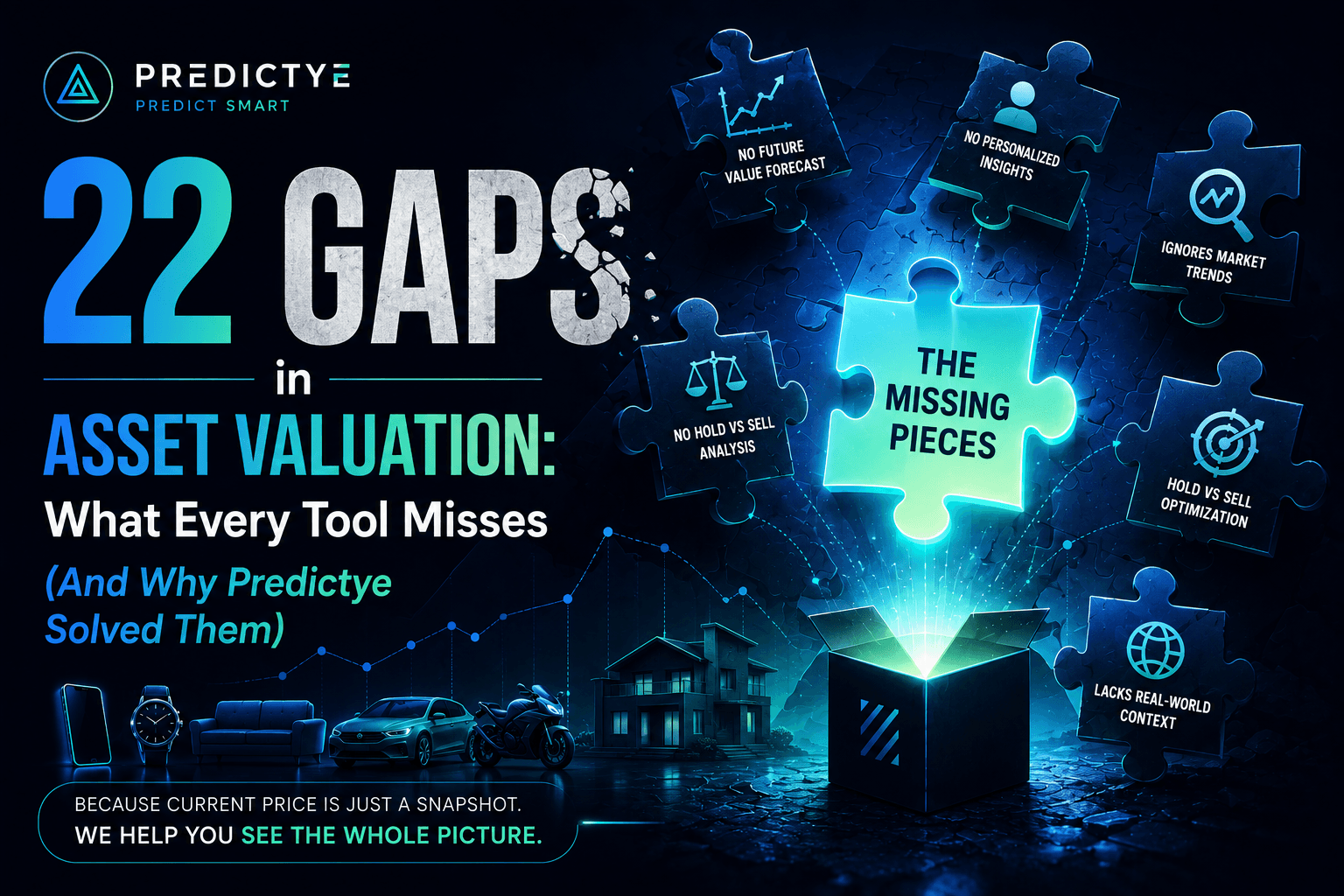
Predictye didn't set out to find 22 gaps. The research started simple: understand the problem. Map it. Build around it.
But once the mapping started, the gaps became unavoidable. Every tool. Every platform. Every approach. All of them missed fundamental pieces of the puzzle.
Here's what Predictye found. All 22 gaps. Organized. Analyzed. And explained.
How These Gaps Are Organized
The 22 gaps cluster into five categories:
- Decision Gaps: The timing and strategy questions
- Valuation Gaps: The assessment and pricing problems
- Intelligence Gaps: The forecasting and understanding gaps
- Distribution Gaps: The platform and logistics problems
- Life Event Gaps: The special situation gaps
- B2B Gaps: The business-to-business problems
Decision Gaps
Gap 1: When to Sell
Nobody answers this question. Every tool shows current price. But the actual question people ask is "should I sell now, or should I wait?" Current price is a snapshot. The decision requires understanding the trajectory.
Predictye found that 46% of people miss the optimal selling window by more than two weeks. That's hundreds of dollars in lost value.
Gap 2: When to Buy
Current tools show today's price. But they don't show whether that price is about to drop because a new model is launching. Or whether you're in a seasonal low. Or whether waiting three months saves you 15%.
Gap 3: Should I Upgrade?
The real cost of upgrading isn't the new price. It's the new price minus what your old item is worth. A $1,200 new phone minus $450 trade-in equals $750 actual upgrade cost. But most people only see the $1,200 number.
Gap 4: What's the Right Timing?
Beyond just when to buy or sell, there are micro-timing questions. Seasonal timing. Announcement timing. Market timing. Nobody surfaces these factors.
Valuation Gaps
Gap 5: Cross-Category Pricing
If you want to value everything in your house, you need five different tools. One for electronics. One for fashion. One for furniture. One for collectibles. One for general items. That's insane.
Gap 6: Condition Assessment
Most tools use simple categories: pristine, good, fair, poor. But condition is more nuanced. A phone with 60% battery health is very different from one with 85% battery health. Same "fair condition" rating. Massive value difference.
Gap 7: Brand Versus Condition
Here's what surprised Predictye: condition matters more than brand. An iPhone in terrible condition is worth less than a Samsung in pristine condition. But most tools treat brand as primary. The data says otherwise.
Gap 8: Hidden Value Factors
Seasonality, model lifecycle, announcement effects, hyper-local pricing. None of these are surfaced anywhere. They're invisible to people making decisions.
Gap 9: Precise Valuation
Every tool gives you a range. "$400-$600." Which is it? Precision matters when making decisions. Predictye went deeper to get specific numbers instead of ranges.
Intelligence Gaps
Gap 10: Pre-Purchase Forecasting
Nobody shows you the depreciation curve before you buy. Nobody says "this item will depreciate $600 over three years, so your true cost of ownership is $1,800."
Gap 11: Depreciation Curves
What will this be worth in one year? Two years? Five years? Depreciation follows curves. Nobody visualizes them.
Gap 12: Cost of Ownership
Price plus depreciation plus usage plus maintenance. What's the real cost of owning this item? Most people only see purchase price.
Gap 13: Future Value Clarity
Will this hold value? Will it tank? Will it appreciate? A Rolex might appreciate 3% per year. A Seiko might depreciate 5% per year. Same product category. Opposite trajectories. Most people don't know this going in.
Distribution Gaps
Gap 14: Where to Sell
Same phone on eBay: $500 net. Same phone on Swappa: $520 net. Same phone on Gazelle: $450 net. Nobody tells you which platform to use for which item.
Gap 15: Platform Comparison
Each platform has different audiences, fee structures, and timelines. But nobody compares them for you.
Gap 16: Fee Transparency
You list an item for $200. How much do you actually get? eBay keeps about 13%. Poshmark keeps 20%. Facebook keeps 0%. Most people don't calculate this.
Life Event Gaps
Gap 17: Moving Sales
You're moving. You have 1,000 items. You need to liquidate fast. Nobody has a framework for what to sell individually, what to bundle, what to donate.
Gap 18: Downsizing
You're getting older. You have a house full of stuff. What goes first? What's worth money? No tool answers this.
Gap 19: Estate Liquidation
A parent passes. You inherit a house full of items. How do you value it? How do you move it? Nobody has a playbook.
B2B Gaps
Gap 20: Bulk Valuation
A pawn shop gets 100 items a day. Current tools take too long for bulk assessment.
Gap 21: Business Intelligence
Resale businesses need demand forecasting. What categories are trending? What's about to peak? Current tools don't answer this.
Gap 22: Inventory Optimization
What should a resale business stock? What should it avoid? No tool gives resale businesses the intelligence they need.
What This Means
Twenty-two gaps. All real. All currently unaddressed.
Predictye was built to close them. Not all at once. But systematically. Starting with the most impactful ones and working down the list.
Direction matters more than snapshots. Trajectory matters more than current price. Decisions matter more than transactions.
That's the foundation. That's what the gaps revealed.